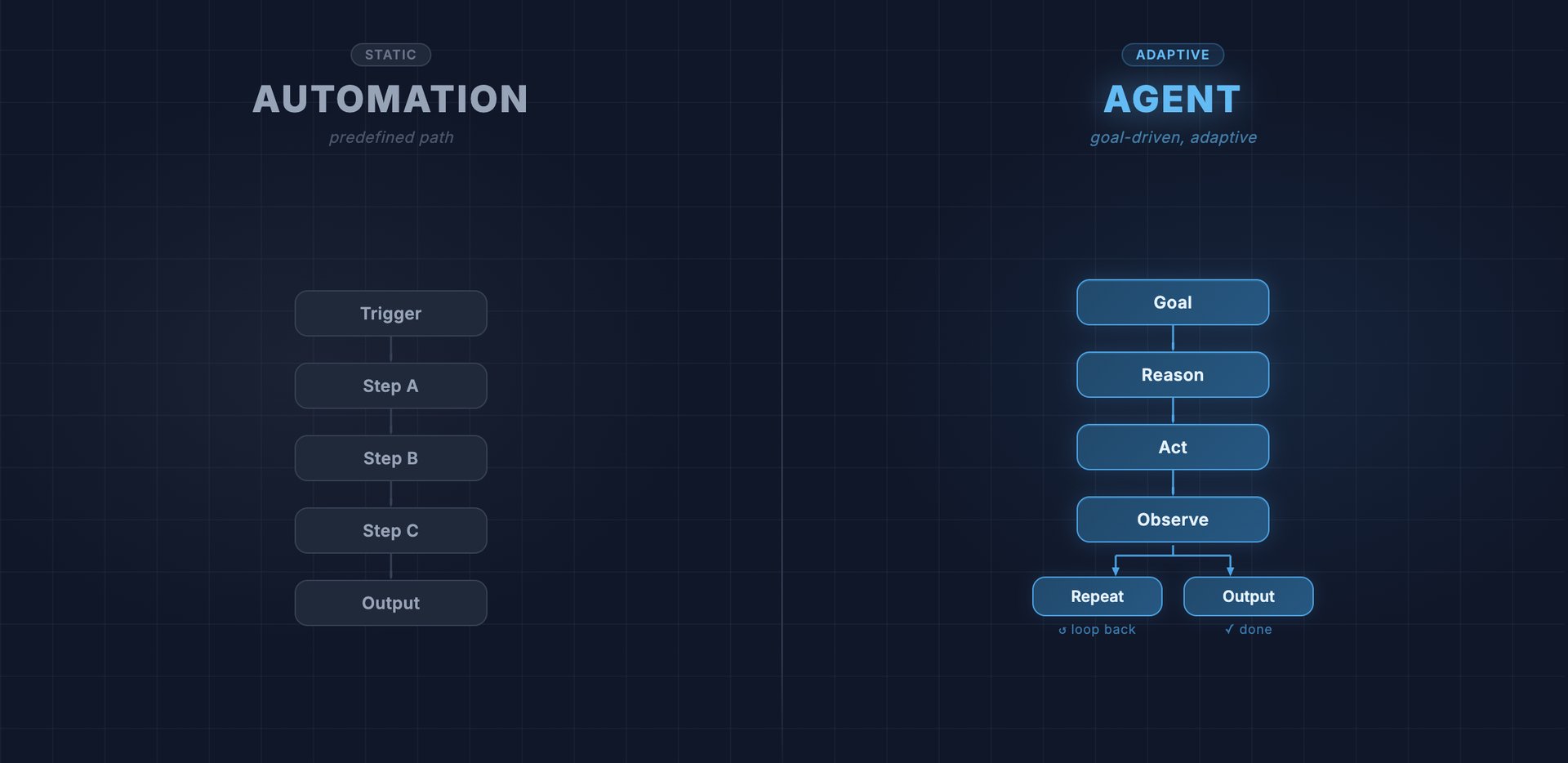
Almost everyone building “AI agents” right now is building automations. Including me, for months.
I had Stella running on a schedule. Every morning: pull intel, summarize, post to Discord. It worked beautifully. I called it my AI agent.
What Most People Are Actually Building
A workflow in n8n, Make, or Zapier follows a predefined path. You define the steps. You decide the logic. The AI — Claude, GPT, Gemini, whatever — sits inside one of those steps and does what you tell it to do.
That’s an automation. A powerful one. But an automation.
Here’s the test I now use for everything I build:
Who decides what happens next — you (via the workflow), or the AI?
If it’s you — through the logic you hardcoded — that’s an automation. The AI is a smart component inside a system you control. Nothing wrong with that. But it’s not an agent.
Meet the Team
Stella is my main agent. Chief of Staff. She handles whatever needs judgment — complex tasks, multi-step decisions, things I can’t fully predict in advance. I call her Stella Jeruk sometimes — her presence is like that orange air freshener in a closed car. Overwhelming, impossible to ignore, and somehow everyone’s more awake when she’s around.
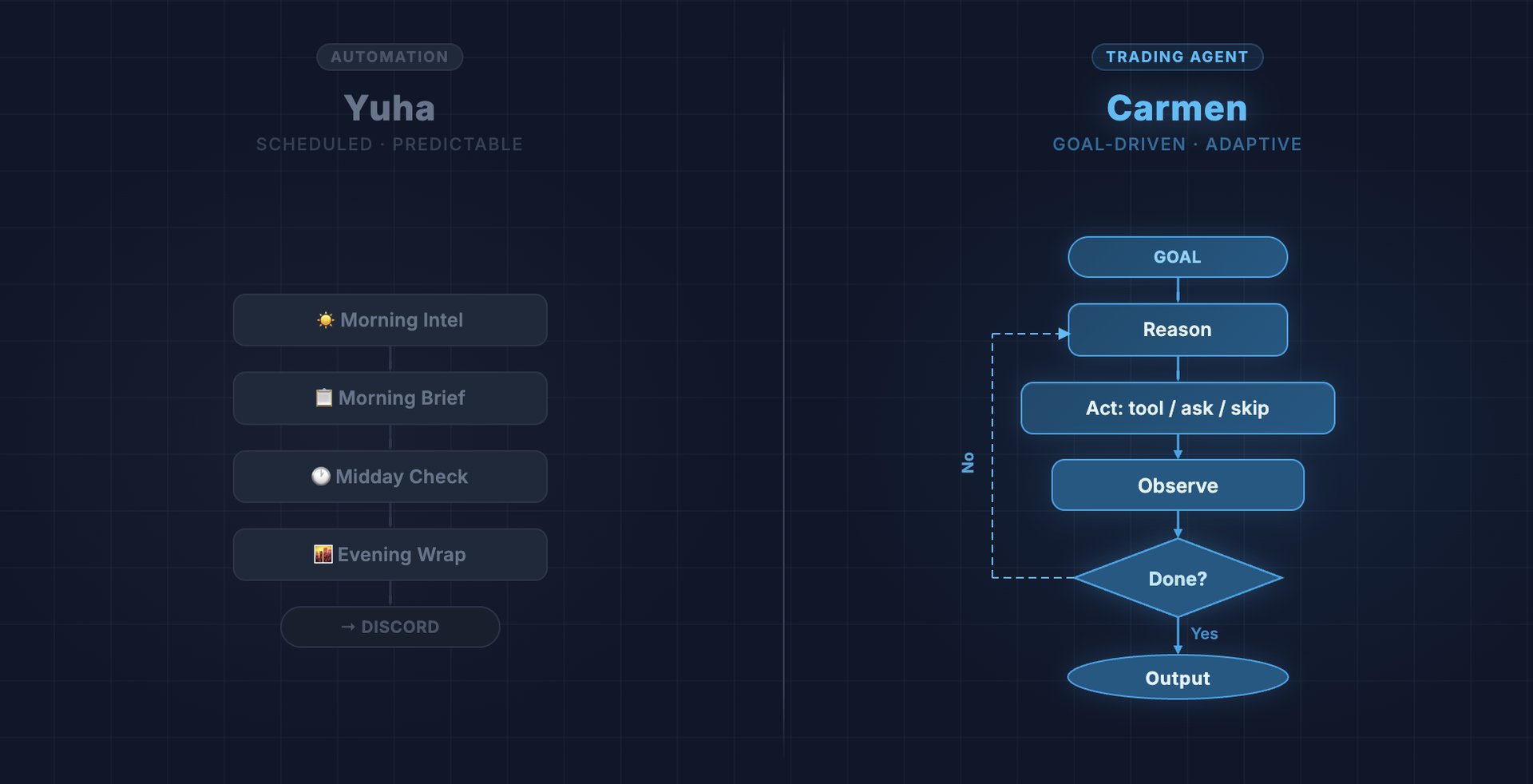
Yuha runs four scheduled jobs a day — morning tech and AI intel, a morning brief covering my unread emails and calendar, a midday check-in, and an evening market wrap. All pushed to Discord automatically.
Jiwoo is my lead engineer — she takes complex technical goals and breaks them into executable tasks.
Carmen watches the markets. She runs a reversal engine on top of price data — looking for the specific setup where a downtrend shows early signs of flipping. When she finds it, she flags it to me. I decide whether to act.
Fun fact: Stella, Yuha, Jiwoo, and Carmen are all members of Hearts2Hearts, an SM Entertainment K-pop group that debuted in 2025. I didn’t plan to name all four after the same group. It just happened.
Automation vs Agent: Where the Line Actually Is
For the first few months, Stella ran on a schedule. Predefined steps, predictable output. That was an automation — useful, reliable, exactly what I needed at the time.
The shift happened when I rebuilt her around a goal instead of a path.
Same objective: produce an intelligent daily brief. But instead of following steps I wrote, Stella now decides how to get there. She can call tools, ask clarifying questions, skip steps that aren’t relevant, or pause and wait if something doesn’t look right.
Yuha’s four cron jobs are automations — scheduled, predictable, efficient. Stella’s work is agentic — goal-driven, adaptive.
Carmen works the same way. She doesn’t follow a fixed script — she reasons about market data until she finds a signal worth flagging. Same idea, different domain.
 That’s the line.
Why Automations Are Still Great
This isn’t an argument against automations. Most of what I run is still automation-based — scheduled, repeatable, cheap.
Automations are better when:
- The task is repetitive with predictable inputs
- You need consistent, debuggable behavior
- Cost matters (agents use more tokens per run)
Agents are better when:
- The task requires judgment
- Inputs vary in ways you can’t fully anticipate
- A decision tree would be too complex to hardcode
They’re not competing. They’re for different jobs. Most production AI systems use both — automations for the predictable parts, agents for the parts that require reasoning.
The mistake is calling one the other. Not because labels matter, but because it shapes how you build. If you think you’re building an agent but you’re actually writing an automation, you’ll design it wrong. You’ll hardcode paths that should be decisions. You’ll hit walls you didn’t expect.
Look at Your Setup
Think about whatever AI thing you’re running right now — a workflow, a bot, a scheduled job. Ask the question:
Who’s making the decisions — you, or the AI?
If it’s you, through the workflow logic you wrote, that’s an automation. Useful. Valid. Keep running it.
But if you want the AI to start making those calls — to reason, to adapt, to handle the edge case you didn’t anticipate — that’s when the architecture needs to change.
I made that shift with Stella. It costs more to run. It also does things I didn’t plan for. Both of those are true.
Next: what running four actual agents 24/7 actually costs — the real numbers, broken down per agent.